Lone runner on an empty mountain road at dawn

The Standard

The TÄGLICH
Standard

A 60-minute, 10-event physical capability test, scored out of 50. Discipline builds freedom.

01

The Standard

The TAGLICH Standard is a 60-minute, 10-event physical capability test scored out of 50. It does not measure how you look, how much you can lift in one all-out effort, or how fast you are at one specialised thing. It measures whether you have a balanced base of physical capability, and it exposes where that base has holes.

The logic behind testing a spread of qualities rather than one is not a style choice. It is what the mortality data points to. Grip strength alone is one of the strongest simple predictors of death: in the 140,000-person PURE study, each 5 kg drop in grip strength was associated with a 16% higher risk of all-cause death and a 17% higher risk of cardiovascular death, a better predictor of cardiovascular death than systolic blood pressure.[1] A meta-analysis of roughly two million people found the strongest individuals had about a 31% lower risk of death than the weakest.[2] Independently, cardiorespiratory fitness shows the same pattern with no observed ceiling: in 122,007 patients, the fittest had the lowest mortality, and being in the lowest fitness quartile carried risk comparable to or exceeding coronary disease, smoking and diabetes.[3] Strength and aerobic fitness predict survival independently of each other, so being strong does not excuse a weak engine, and a strong engine does not excuse being weak.[4]

That is the whole thesis in one line: a single quality cannot cover for a missing one, so the test refuses to let any single quality hide a gap.

02

How It Is Scored

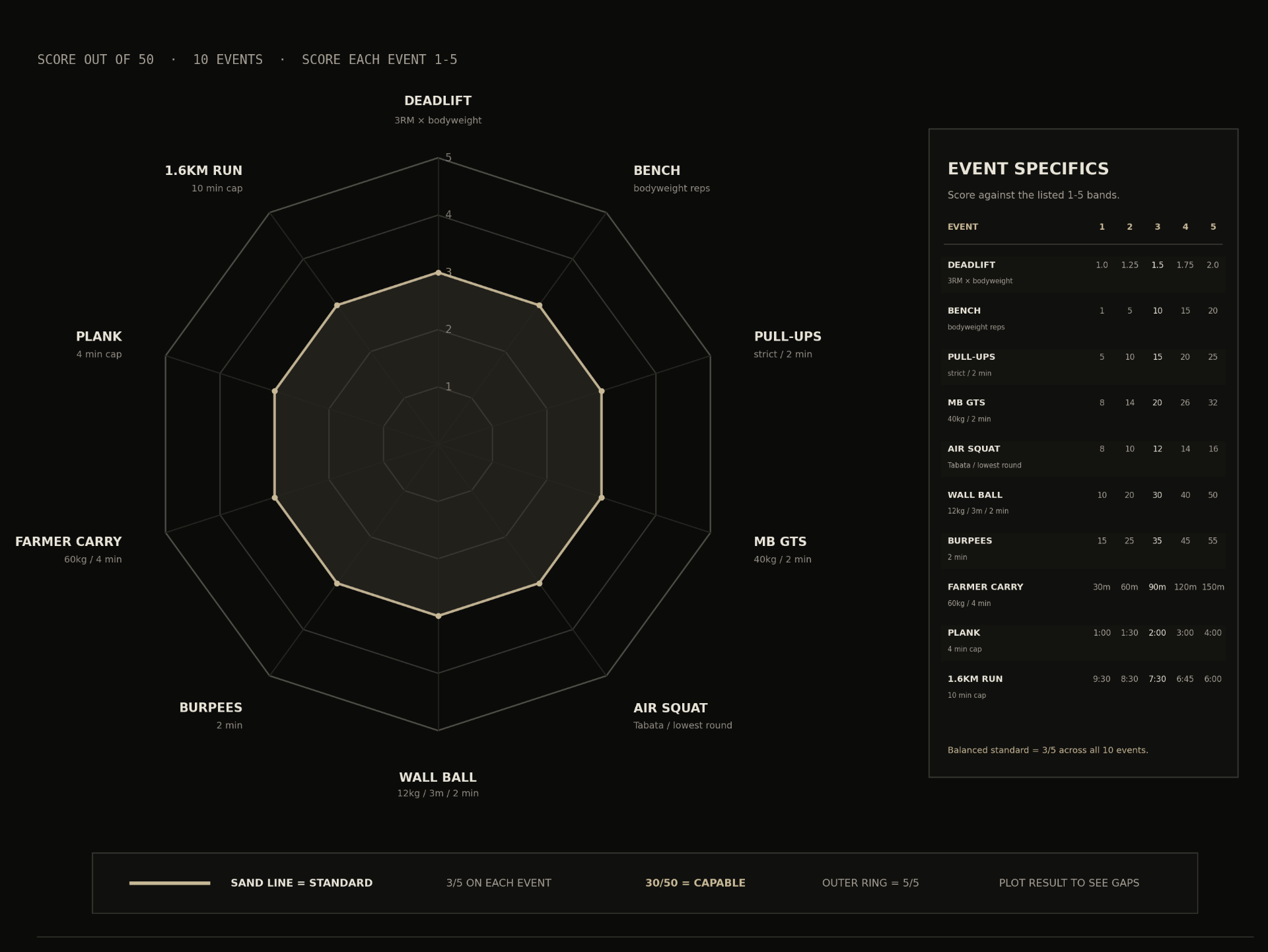
Ten events, each scored 1 to 5 against fixed standards, totalled out of 50. Your total places you on one of five levels. Because every event is capped at 5, you cannot buy back a failed event with a huge score elsewhere. A 50 deadlift and a zero run still leaves a hole on the page. The events run in a deliberate order, heaviest strength demands first while fresh, the run last when you are already fatigued, for the reasons given under each event.

Capability Profile spider graph showing 10 events scored 1-5 with the 3/5 sand-line standard

The Five Levels

ScoreLevelMeaning
0–19LiabilityYou have to cover for them. Relying on them is a risk. Clear physical gaps.
20–29DependentNot a danger, but you are being carried. Cannot yet hold their own weight.
30–37CapableCarries their own weight. Meets the TAGLICH Standard.
38–44AssetNot just their share. Strong across most areas.
45–50MultiplierMakes everyone around them better. Top-end civilian result.

Scoring Standards

ExerciseDetail12345
Deadlift3RM, × bodyweight1.01.251.51.752.0
Bench PressBodyweight reps15101520
Pull-UpsStrict / 2 min510152025
MB GTS40 kg / 2 min814202632
Air SquatTabata / lowest round810121416
Wall Ball12 kg / 3 m / 2 min1020304050
Burpees2 min1525354555
Farmer Carry60 kg / 4 min30 m60 m90 m120 m150 m
Front Plank4 min cap1:001:302:003:004:00
1.6 km Run10 min cap9:308:307:306:456:00

Section 1

Strength

Can you produce force?

01

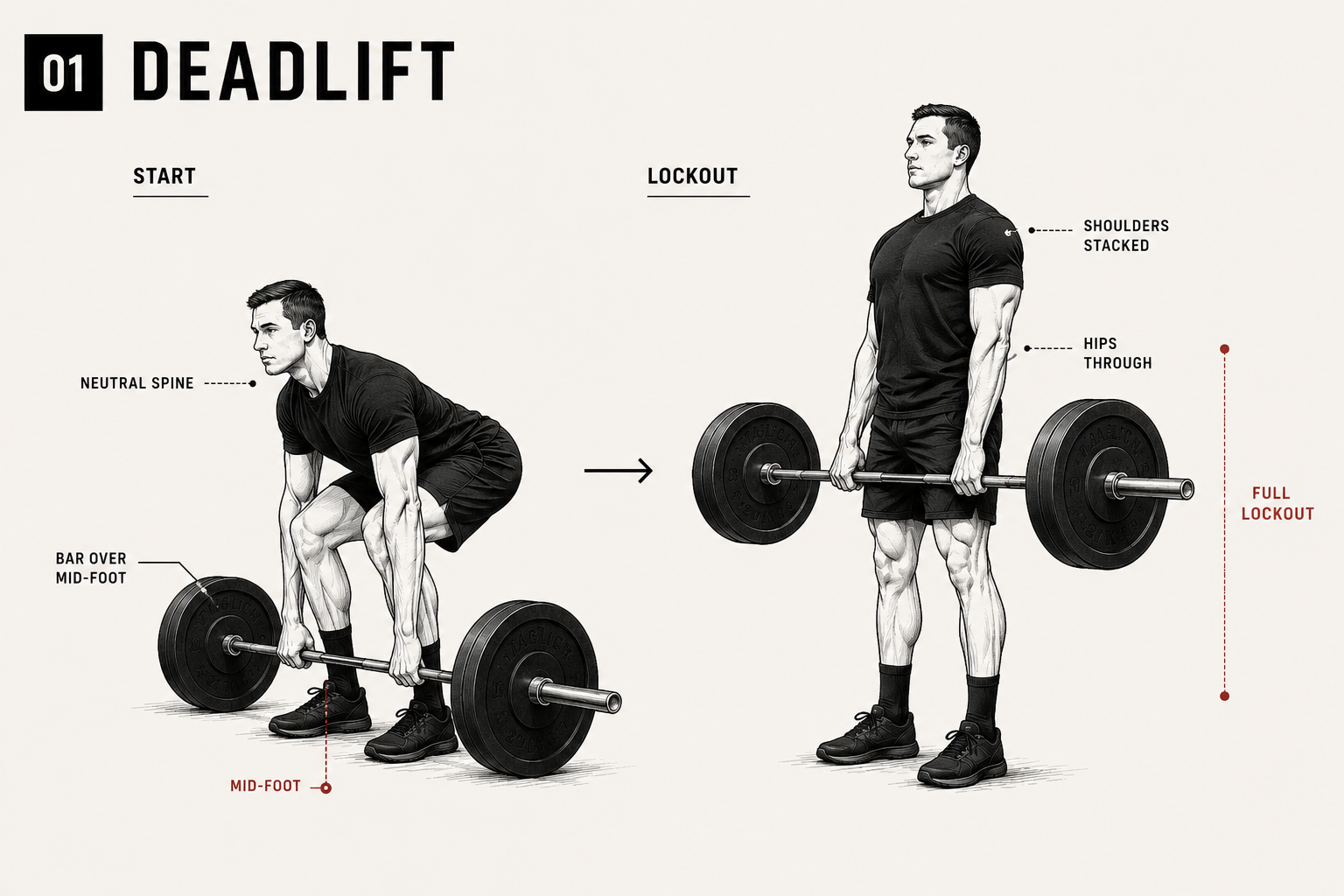
Deadlift setup and lockout standards diagram for The Standard

Deadlift 3-rep max for load.

Rules

Work up to a heavy 3-rep max from the floor, conventional or sumo, double-overhand or mixed grip, no straps. Three reps, no bouncing the bar, full lockout each rep. Scored as a multiple of bodyweight: 1.0×, 1.25×, 1.5×, 1.75×, 2.0× for 1 to 5. Tested first, before any fatigue.

Why it matters

The deadlift recruits more total muscle mass under load than almost any other lift. EMG confirms it maximally drives the erector spinae and the entire posterior chain, the hamstrings, glutes and spinal extensors, at once.[6] That total-body recruitment also makes it the most systemically demanding lift, which is why it is tested first, before fatigue. After heavy compound lifting, parasympathetic (vagal) heart-rate-variability markers are suppressed and do not fully return to baseline for around 48 hours, with perceived fatigue still elevated at 48 hours.[7] We test a 3-rep max rather than a true 1-rep max deliberately. It is still genuinely heavy and a valid strength marker, but it carries far less injury risk than a maximal single, so the whole standard does not hinge on one risky rep.
02

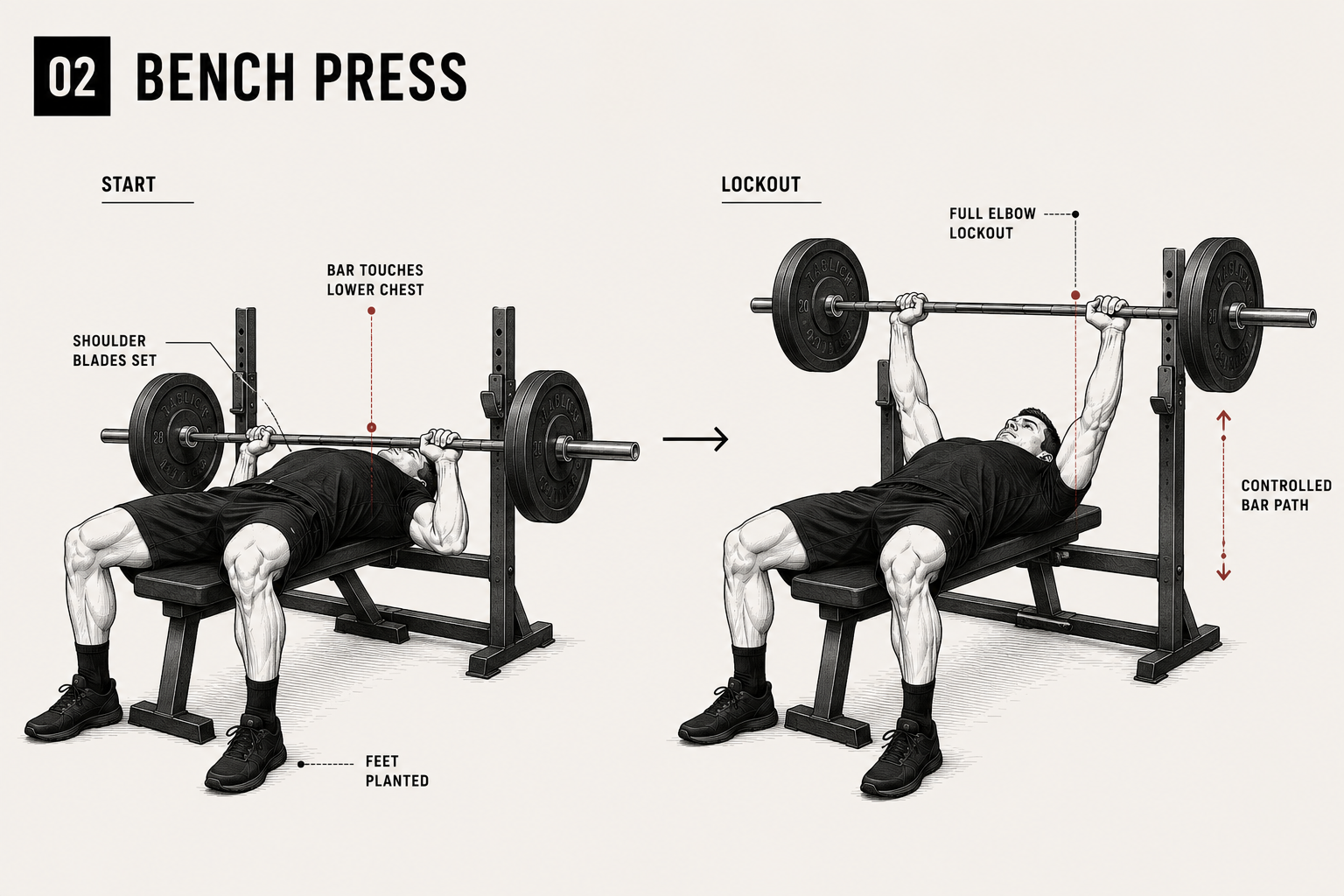
Bench press start and lockout standards diagram for The Standard

Bench press bodyweight for max reps.

Rules

Barbell loaded to exactly your bodyweight. Max strict reps, full range (bar to chest, full lockout), no bouncing, hips on the bench. Reps: 1, 5, 10, 15, 20 for 1 to 5.

Why it matters

This is upper-body pressing strength expressed relative to your own mass, which is the point. A raw 1-rep max bench rewards being heavy. Loading the bar to bodyweight removes that, because a bigger person must press a proportionally bigger bar, so the test reads strength to size rather than size alone. Relative strength, force per kilogram of bodyweight, is the more meaningful number for real-world capability and for most athletic transfer, because in the real world you usually have to move loads and yourself.[1],[2] It captures the pressing half of upper-body function: pushing something or someone away, creating space, and transmitting force through the chest, shoulders and triceps with a braced trunk.

Strength Block Warm-Up & Pacing

0:00 → 16:00

General mobility is done before the clock starts. The 16 minutes is barbell ramp plus scored lifts only, so the warm-up has to do its job without eating the window. Use an ascending pyramid: load goes up, reps come down. Every warm-up set is a primer kept two or more reps shy of failure, and only the scored set is taken to the limit. Rest grows as the bar gets heavy but stays short enough to protect the clock.

Deadlift to 3RM (≈ 0:00 → 9:00)

SetLoad (% of 3RM target)RepsRest
1Bar / ~40%545 s
2~55%560 s
3~70%375 s
4~82%290 s
5~90%1 (primer single)2 min
Scored100% (3RM)3

Bench to Bodyweight Max Reps (≈ 9:00 → 16:00)

SetLoadRepsRest
1Empty bar (20 kg)845 s
2~50% bodyweight560 s
3~75% bodyweight390 s
ScoredBodyweightAMRAP

If the top deadlift set moved fast and clean, take one more attempt up about 2.5–5%, with a 2-minute rest, but land it by 9:00. If you are unsure, pick a load you know you have for three. A missed 3-rep max still burns the clock. Keep chalk, plate changes and set-up tight, because transitions count against the 16.

Section 2

Capacity

Can you keep producing clean work under fatigue?

03

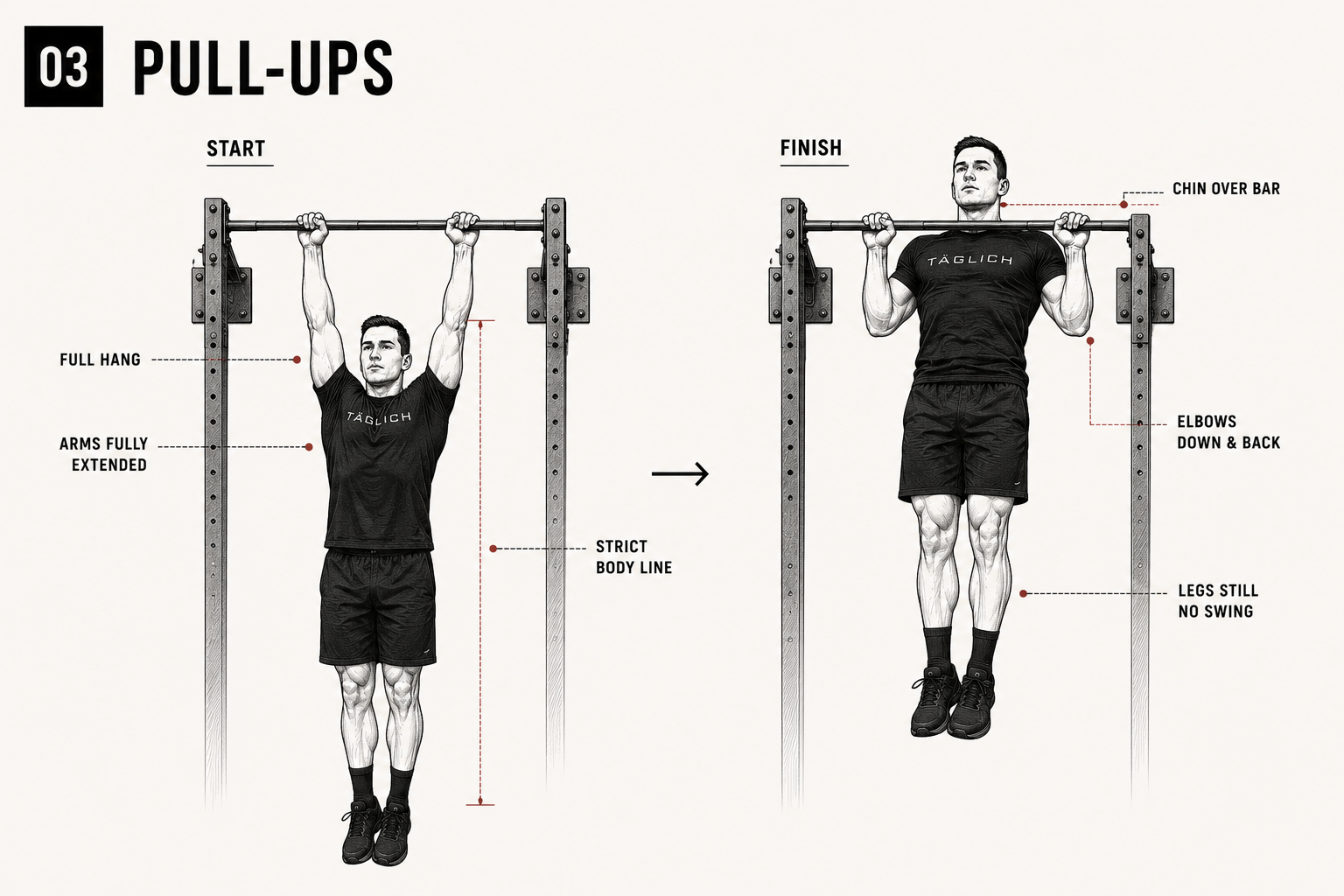
Strict pull-up start and finish standards diagram for The Standard

Strict pull-ups for max reps in 2 minutes.

Rules

Dead-hang start, chin clearly over the bar, full extension at the bottom of each rep. Strict only: no kipping, no swinging, no half reps. As many as you can inside 2 minutes (you may rest on the bar). Reps: 5, 10, 15, 20, 25 for 1 to 5.

Why it matters

The pull-up is the great equaliser of pulling strength because, like the bodyweight bench, it is normalised to your own mass. You cannot out-lever it with machines or excess weight, because every extra kilogram is a kilogram you must pull.[1],[2] Strict standards exist to stop the body cheating: kipping turns a strength test into a coordination and hip-drive test and hides genuine pulling weakness. It is the clearest single read of vertical pulling, grip endurance and scapular control.

04

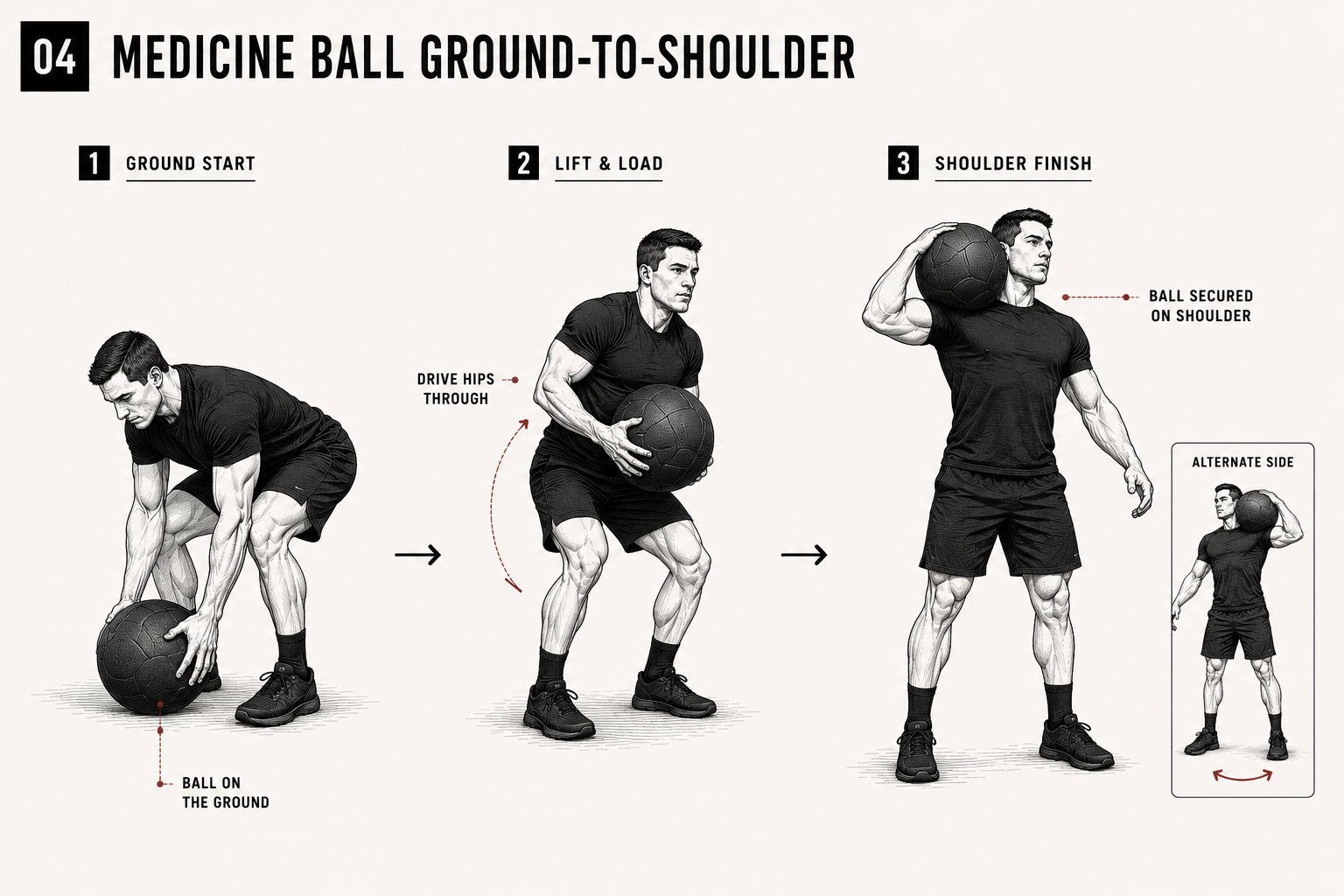
Medicine ball ground-to-shoulder movement standards diagram for The Standard

40 kg medicine-ball ground-to-shoulder for reps in 2 minutes.

Rules

Lift a 40 kg ball (or equivalent odd object) from the floor to the shoulder, stand fully, then return it to the floor under control. Alternate shoulders as you like. Reps in 2 minutes: 8, 14, 20, 26, 32 for 1 to 5.

Why it matters

Almost nothing in real life has knurled handles and perfect balance. An awkward, shifting object forces the body to generate and stabilise force without ideal leverage, and the evidence shows odd-object lifting is uniquely demanding on exactly the structures that protect you. McGill biomechanical work on strongman-style odd-object lifts recorded some of the highest trunk and hip muscle activation levels ever measured, with very high spinal loads and stiffness demands, often greater than barbell equivalents.[8] Systematic review of strongman and odd-object training confirms its strong carryover to real-world and occupational lifting tasks.[14] This is the event that asks whether you can pick a heavy, inconvenient thing off the floor, repeatedly, without folding, which is the most common way people actually hurt themselves.

05

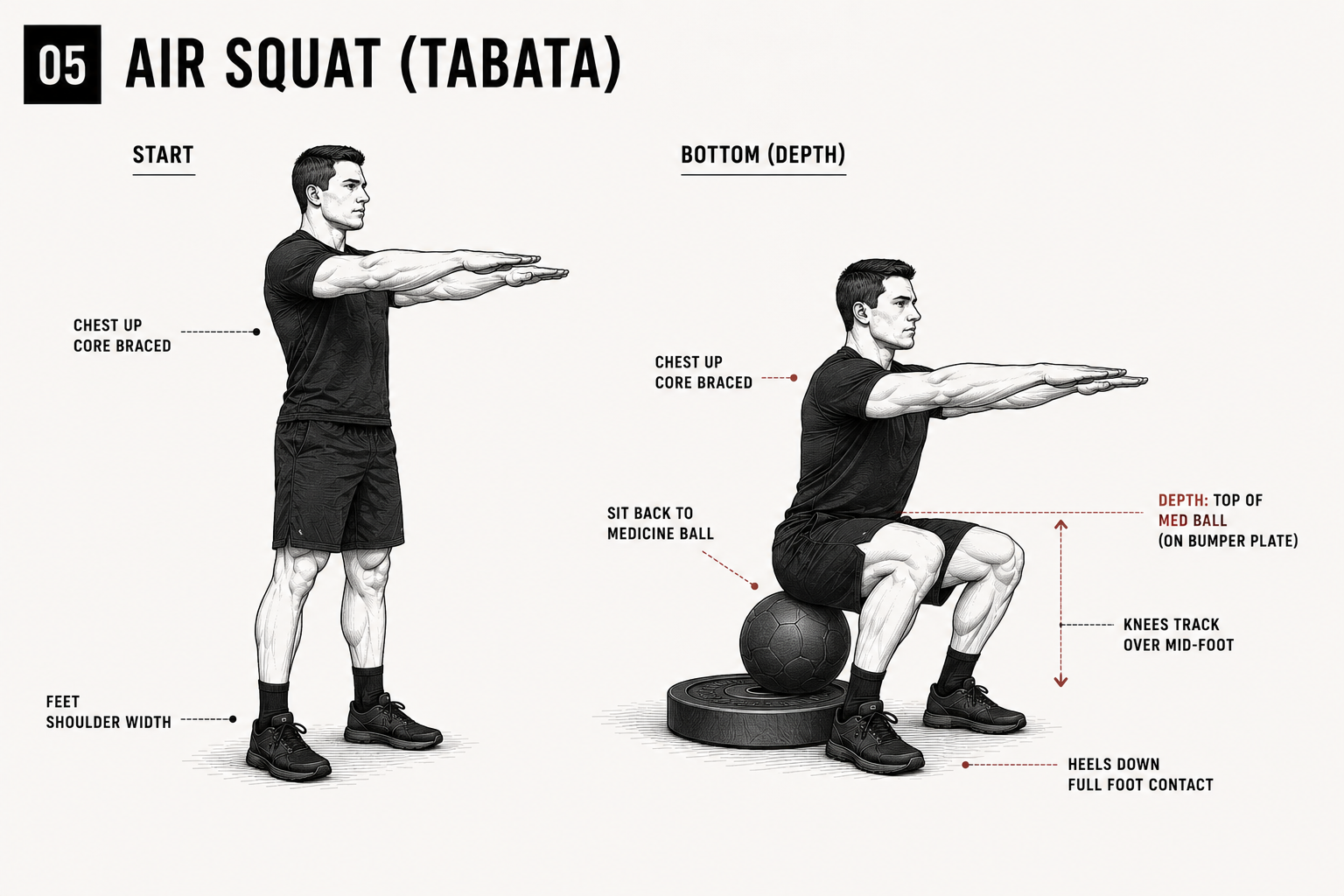
Air squat tabata start and bottom position standards diagram for The Standard

Tabata air squat, 8 rounds of 20:10, scored on the lowest round.

Rules

The Tabata protocol: 8 rounds of 20 seconds of bodyweight squats and 10 seconds of rest (4 minutes total), full depth (hip crease below knee), full stand. Your score is your lowest round, not your total and not your first. Lowest-round reps: 8, 10, 12, 14, 16 for 1 to 5.

Why it matters

The Tabata structure is not arbitrary. It is the actual protocol from the 1996 Tabata study, where 20-on, 10-off intervals at about 170% of VO2max improved both the aerobic system (VO2max up about 7 ml per kg per minute) and the anaerobic system (capacity up 28%) in six weeks.[5] That dual demand is the point: it tests leg endurance where the aerobic and anaerobic systems overlap. Scoring the lowest round is deliberate. It removes the reward for sandbagging a huge first round and blowing up, and instead rewards repeatable output, which is what fatigue resistance actually means. Lower-body endurance and power also have standalone predictive value: low relative sit-to-stand (leg) power is associated with significantly higher all-cause mortality in older adults.[9]

06

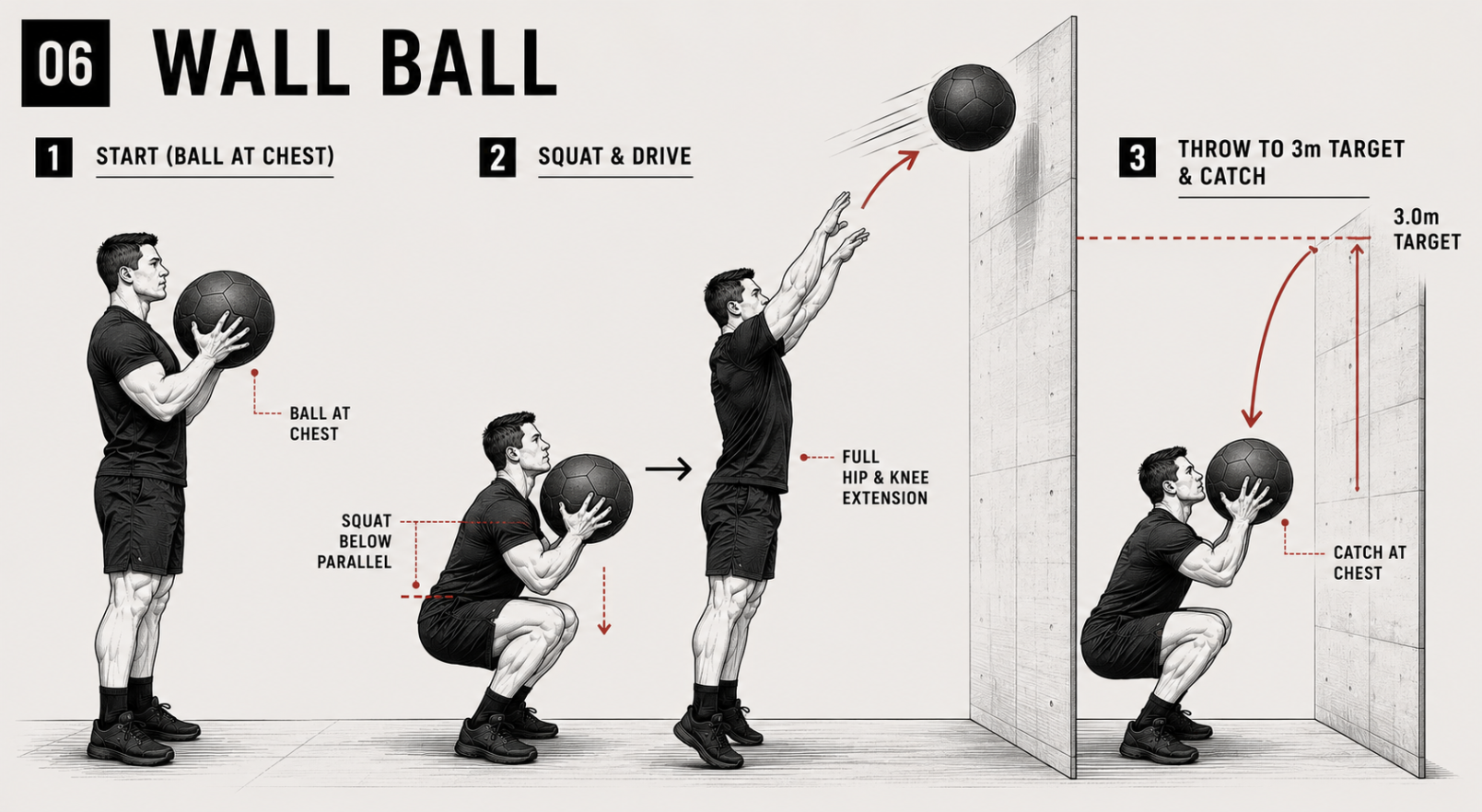
Wall ball sequence and target standards diagram for The Standard

12 kg wall ball to a 3 m target for reps in 2 minutes.

Rules

12 kg ball, full squat below parallel, drive up and throw to a 3 m target, catch and descend into the next rep. A rep counts only if the target is hit. Reps in 2 minutes: 10, 20, 30, 40, 50 for 1 to 5.

Why it matters

This is the test overhead pattern and its hardest-to-fake conditioning piece. It chains a full squat to an overhead throw, linking legs, trunk, shoulders, breathing and timing into one cycle. Compound full-range movements like this drive heart rate and oxygen cost sharply, because so many large muscle groups work at once.[12] The 12 kg load is chosen on purpose. Standard wall balls are often light enough to be pure cardio, whereas 12 kg makes it a genuine strength-endurance task: you have to keep producing force overhead while breathing hard and holding posture.

07

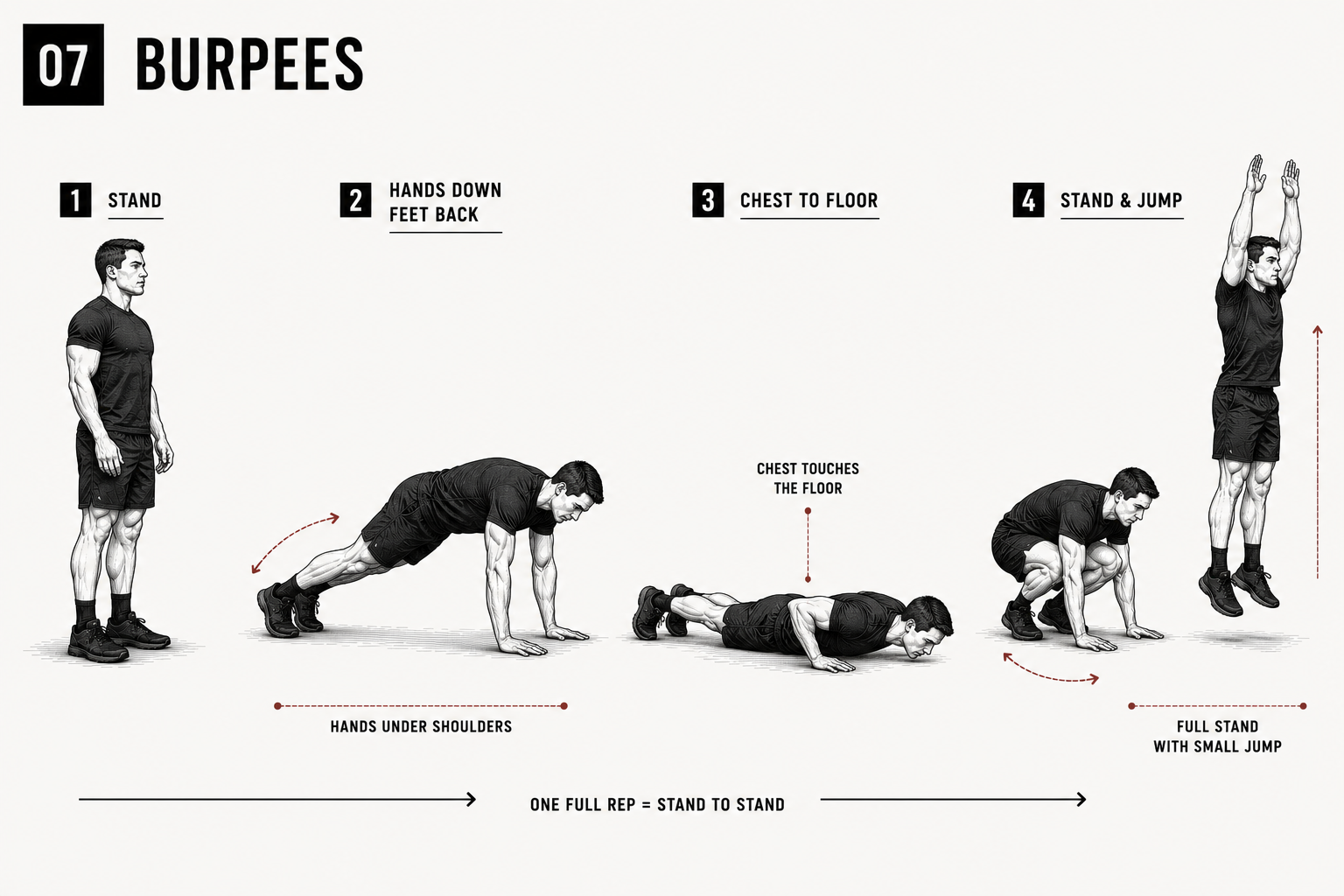
Burpee movement sequence standards diagram for The Standard

Burpees for max reps in 2 minutes.

Rules

Chest to floor at the bottom, full stand with a jump and hands overhead at the top. Max reps in 2 minutes: 15, 25, 35, 45, 55 for 1 to 5.

Why it matters

Burpees are simple, need no equipment, and are almost impossible to hide from. They punish excess bodyweight, poor conditioning and bad pacing all at once. They are a validated whole-body high-intensity stimulus: low-volume burpee interval training produces meaningful cardiometabolic and power adaptations comparable to sprint-interval training, and whole-body HIIT of this type drives VO2max gains on par with steady-state cardio.[12] As a test item they read full-body fatigue tolerance and the basic, survival-relevant skill of getting off the floor and back up, over and over.

Section 3

Structure

Can you hold posture under load and fatigue?

08

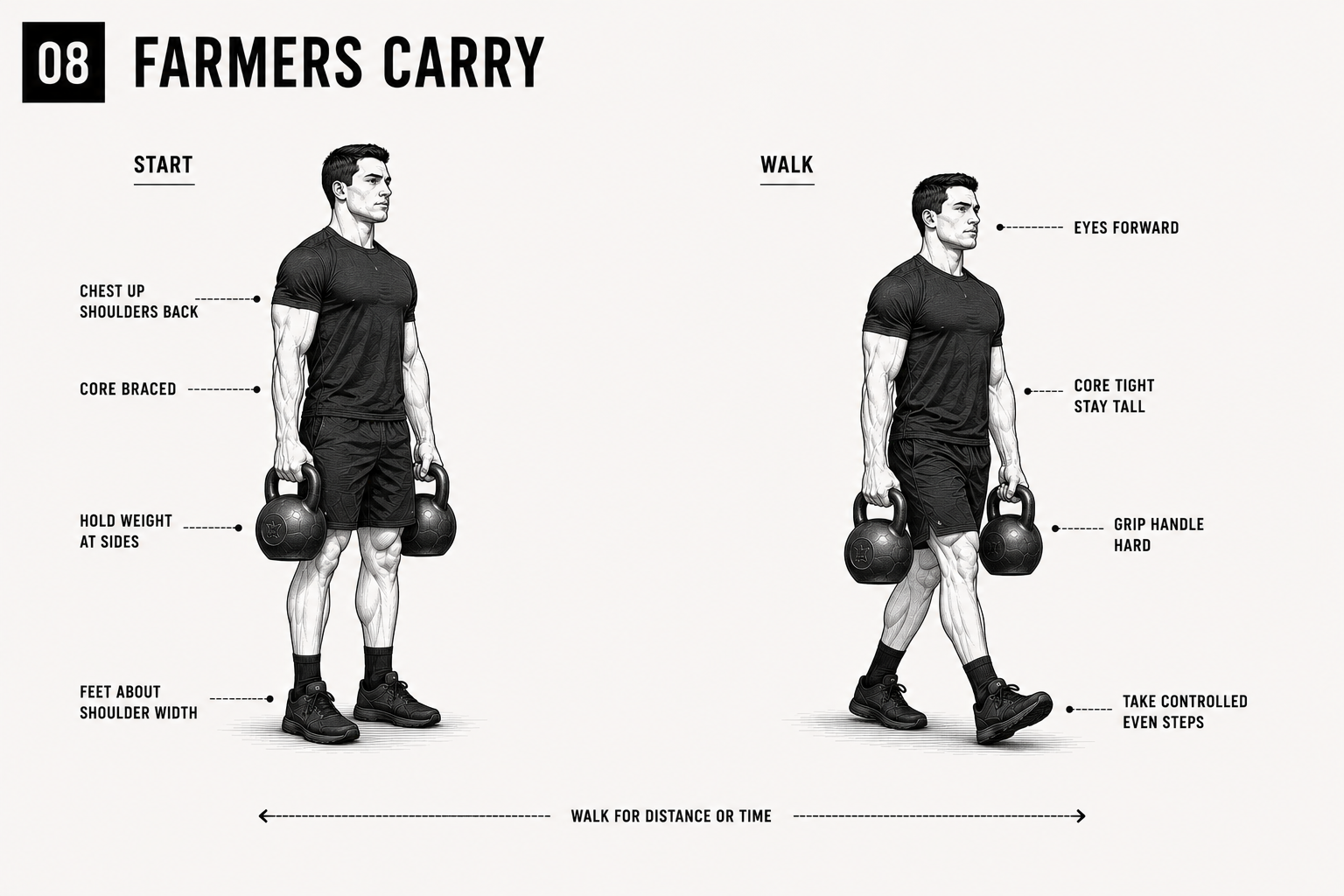
Farmer carry start and walk position standards diagram for The Standard

Farmer carry for distance, 30 kg each hand, 4 minutes.

Rules

Two 30 kg implements (dumbbells or handles), carried for distance over 4 minutes. You may set down and re-grip, but the clock keeps running. Distance: 30, 60, 90, 120, 150 m for 1 to 5.

Why it matters

The loaded carry is grip, traps, trunk stiffness, posture and breathing welded into one task, and it is about as real-world as a test gets. EMG quantification of the loaded-carry pattern shows high simultaneous activation of the spinal extensors, abdominals and obliques, with the load constantly trying to tip and sway you, demanding continuous trunk co-contraction.[13] Grip is the hidden star. It is not just hand strength but a proxy for whole-body strength and physiological reserve, which is why it tracks so tightly with mortality.[1] Loaded carrying maps almost directly to the demands of real life, which is why it is often considered more functional than static core work.[13]

09

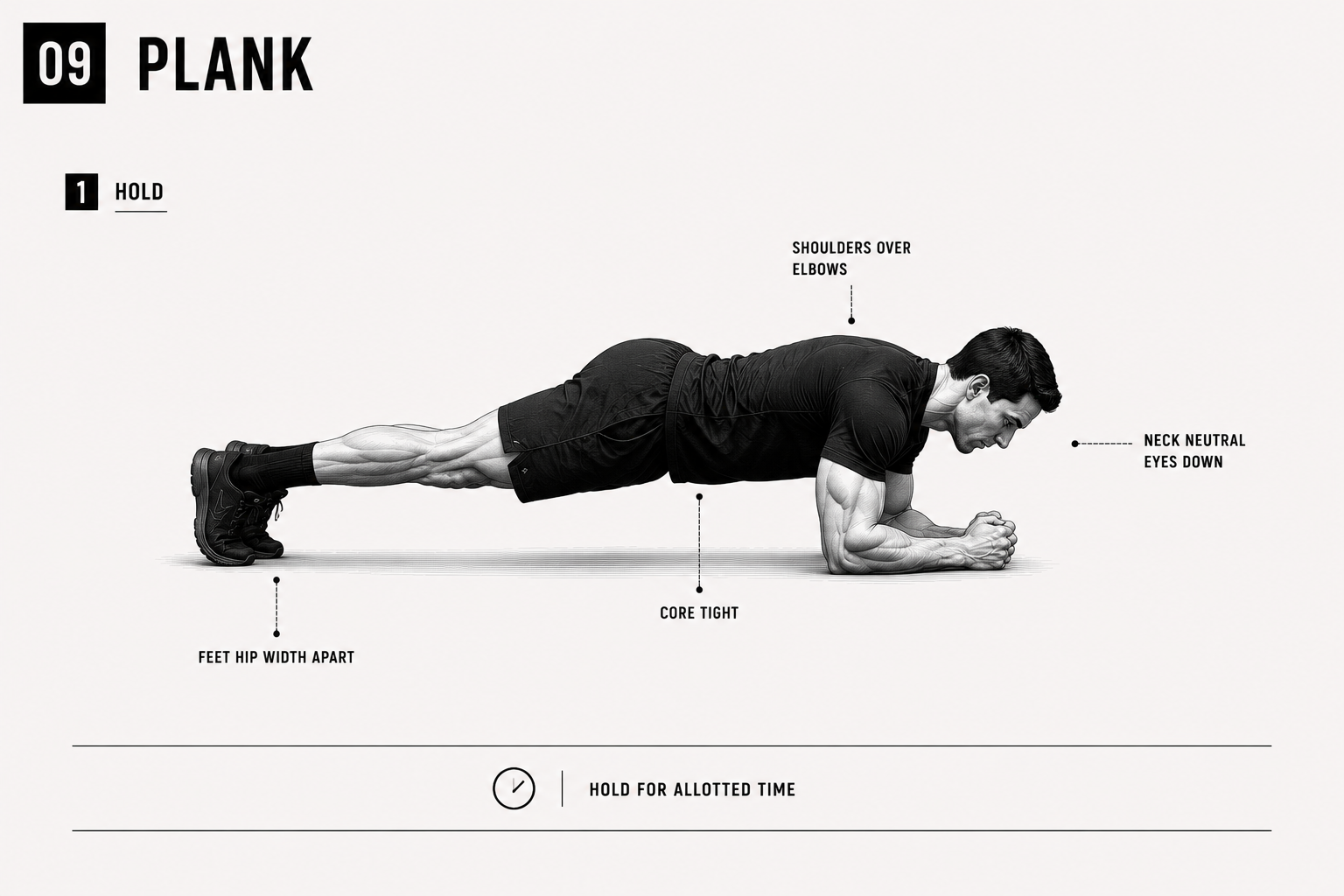
Front plank hold position standards diagram for The Standard

Front plank for time, 4-minute cap.

Rules

Forearm plank, straight line from heel to head, hips neither sagging nor piked. Hold to failure or to the 4-minute cap. Time: 1:00, 1:30, 2:00, 3:00, 4:00 for 1 to 5.

Why it matters

We test an isometric hold rather than sit-ups on purpose. McGill spine research shows that repeated spinal flexion, exactly what crunches and sit-ups train, is a primary mechanism of disc damage, whereas the trunk real job is to resist movement and transfer force without leaking it.[8] The plank trains and tests that anti-extension, brace-and-hold quality directly. Trunk endurance specifically, not just strength, has long been linked to back health: in the classic Biering-Sorensen prospective study of over 900 people, poorer trunk-muscle endurance predicted first-time low-back pain in the following year.[10] A trunk that leaks under fatigue makes every other event worse, lifting, carrying, running and overhead work, which is why it earns its own test.

Section 4

Engine

Can you move?

10

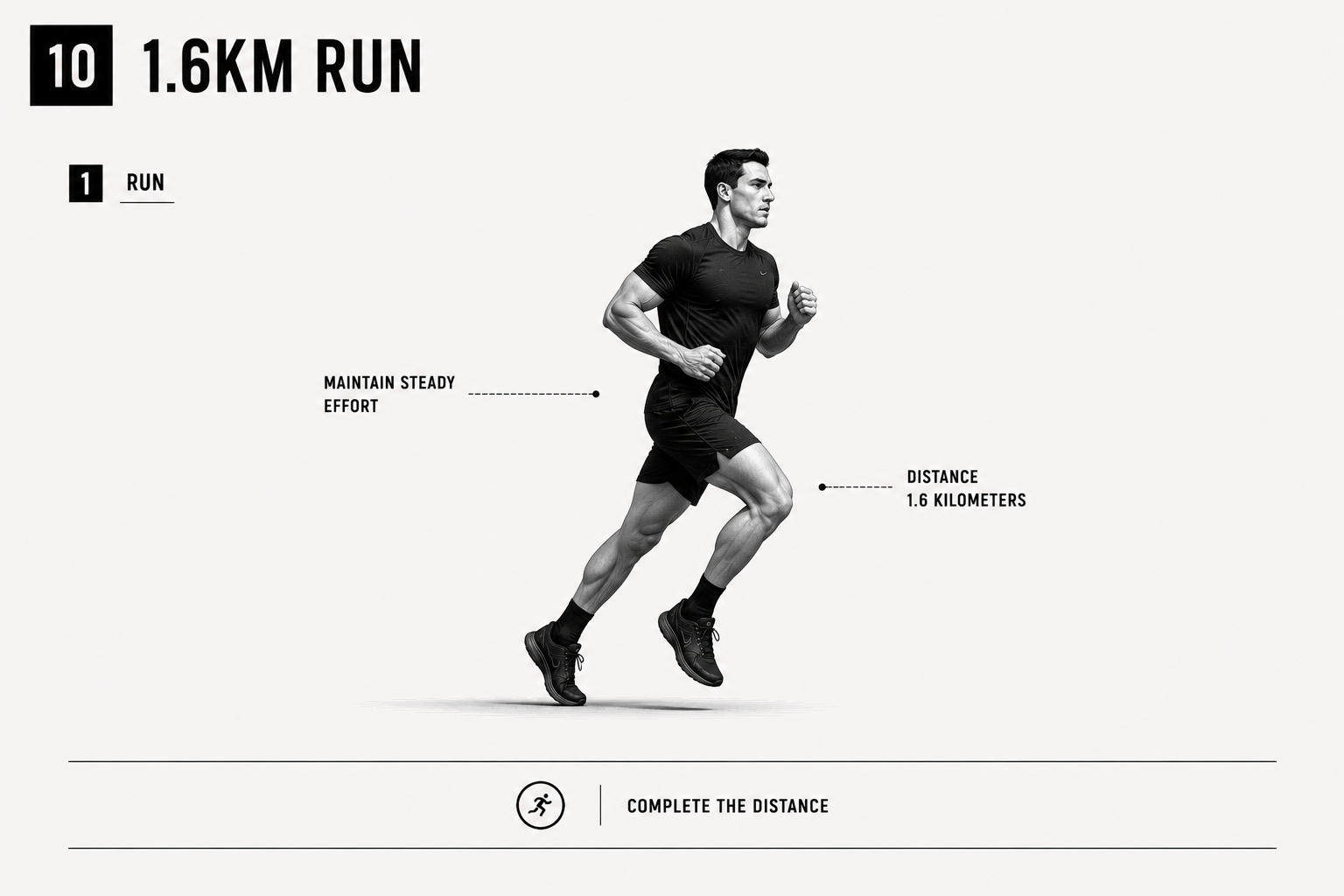
1.6 kilometre run event graphic for The Standard

1.6 km run for time, 10-minute cap.

Rules

1.6 km (1 mile) for time, run last, after everything else. Time: 9:30, 8:30, 7:30, 6:45, 6:00 for 1 to 5.

Why it matters

The 1.6 km distance sits in the middle-distance zone where both energy systems matter. Direct measurement of energy-system contribution puts the 1500 m event at roughly 84% aerobic and 16% anaerobic, strongly aerobic but carrying the largest anaerobic share of the distance events.[11] It is long enough to demand real aerobic capacity yet short enough that you cannot switch the anaerobic system off, the uncomfortable middle. It is run last, on tired legs, on purpose. A fresh mile mostly measures your engine, but a mile after deadlifts, carries, wall balls and burpees measures your engine plus your ability to keep moving when everything already hurts.[3]

03

The 60-Minute Run Sheet

TimeBlockEventNotes
0:00–16:00StrengthDeadlift 3RM + Bodyweight BenchIncludes the pyramid above
16:00–18:00Repeatable OutputStrict Pull-Ups2-min scored window
18:00–20:00RestFixedBreathe, set up next station
20:00–22:00Repeatable Output40 kg MB Ground-to-Shoulder2-min scored window
22:00–24:00RestFixed
24:00–28:00Repeatable OutputAir Squat Tabata4 min, 8 × 20s/10s
28:00–30:00RestFixed
30:00–32:00Repeatable Output12 kg Wall Balls2-min scored window
32:00–34:00RestFixed
34:00–36:00Repeatable OutputBurpees2-min scored window
36:00–38:00RestFixed
38:00–42:00Structural Endurance60 kg Farmer Carry4-min window for distance
42:00–44:00RestFixed
44:00–48:00Structural EnduranceFront Plank4-min cap
48:00–50:00RestTransition to runGet to the start line
50:00–60:00Engine1.6 km Run10-min cap

Two things keep scores comparable across people. The rests are fixed and mandatory: you take them whether you feel you need them or not, because standardised rest is what makes two scores mean the same thing. And the 2-minute windows are the scored windows: work performed outside them does not count. The order is deliberate, with pull-ups coming straight off the strength block while you are warm, and the fixed rests doubling as set-up time for the next station.

What a Good Score Means

A good score means the person can produce force (deadlift, bench), move their own bodyweight (pull-ups), keep producing clean work under fatigue (the capacity block), hold structure under load (carry, plank), and still move at the end (the run). The independent mortality signals behind strength, grip, trunk endurance and aerobic fitness mean those are not arbitrary boxes. They are the qualities that track with staying capable, and with staying alive.[1],[2],[3],[4] Not specialised fitness. General physical capability.

04

References

  1. [1]Leong DP, et al. Prognostic value of grip strength: findings from the Prospective Urban Rural Epidemiology (PURE) study. The Lancet. 2015;386(9990):266–273. https://www.thelancet.com/journals/lancet/article/PIIS0140-6736(14)62000-6/abstract
  2. [2]García-Hermoso A, et al. Muscular Strength as a Predictor of All-Cause Mortality in an Apparently Healthy Population: meta-analysis of approximately 2 million men and women. Arch Phys Med Rehabil. 2018. https://pubmed.ncbi.nlm.nih.gov/29425700/
  3. [3]Mandsager K, et al. Association of Cardiorespiratory Fitness With Long-term Mortality Among Adults Undergoing Exercise Treadmill Testing. JAMA Network Open. 2018;1(6):e183605. https://pmc.ncbi.nlm.nih.gov/articles/PMC6324439/
  4. [4]Comparison of Muscle Strength and Cardiorespiratory Fitness in Relation to Cardiovascular and All-Cause Mortality: The Copenhagen City Heart Study. Mayo Clin Proc. 2024. https://www.mayoclinicproceedings.org/article/S0025-6196(24)00413-0/abstract
  5. [5]Tabata I, et al. Effects of moderate-intensity endurance and high-intensity intermittent training on anaerobic capacity and VO2max. Med Sci Sports Exerc. 1996;28(10):1327–1330. https://pubmed.ncbi.nlm.nih.gov/8897392/
  6. [6]Martin-Fuentes I, Oliva-Lozano JM, Muyor JM. Electromyographic activity in deadlift exercise and its variants: a systematic review. PLoS One. 2020;15(2):e0229507. https://journals.plos.org/plosone/article?id=10.1371/journal.pone.0229507
  7. [7]Heart Rate Variability, Neuromuscular and Perceptual Recovery Following Resistance Training. Sports (Basel). 2019;7(10):225. https://www.ncbi.nlm.nih.gov/pmc/articles/PMC6835520/
  8. [8]McGill SM, McDermott A, Fenwick CMJ. Comparison of different strongman events: trunk muscle activation and lumbar spine motion, load, and stiffness. J Strength Cond Res. 2009;23(4):1148–1161. https://pubmed.ncbi.nlm.nih.gov/19528856/
  9. [9]Low relative sit-to-stand power is associated with falls, fractures, hospitalization and all-cause mortality in older adults (Toledo Study for Healthy Aging). https://www.sciencedirect.com/science/article/pii/S2095254625000614
  10. [10]Biering-Sørensen F. Physical measurements as risk indicators for low-back trouble over a one-year period. Spine. 1984;9(2):106–119. https://www.sralab.org/rehabilitation-measures/biering-sorensen-test
  11. [11]Spencer MR, Gastin PB. Energy system contribution during 200- to 1500-m running in highly trained athletes. Med Sci Sports Exerc. 2001;33(1):157–162. https://journals.lww.com/acsm-msse/Fulltext/2001/01000/Energy_system_contribution_during_200__to_1500_m.24.aspx
  12. [12]Extremely Low-Volume Burpee Interval Training improves performance versus Sprint Interval Training. J Strength Cond Res. 2023; and single-exercise whole-body HIIT improves aerobic fitness (IJES). https://pubmed.ncbi.nlm.nih.gov/37639674/
  13. [13]The Quantification of Muscle Activation During the Loaded Carry Movement Pattern. 2024. https://www.ncbi.nlm.nih.gov/pmc/articles/PMC11042841/
  14. [14]Winwood PW, et al. The Biomechanics and Applications of Strongman Exercises: a Systematic Review. Sports Medicine - Open. 2019. https://sportsmedicine-open.springeropen.com/articles/10.1186/s40798-019-0222-z